Sunday, April 12, 2009

The utmost importance of national flag of india.

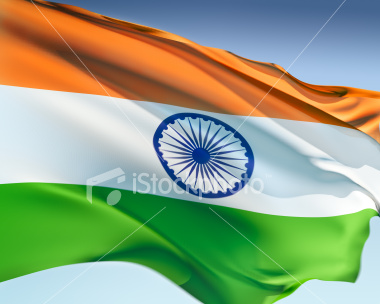
  • Born on July 22, 1947 in the Constituent Assembly on the eve of the Independence, the Indian national Flag is a horizontal tricolor. When the adhoc Committee on the Flag adopted it as the National Flag of free India, Jawaharlal Nehru made a memorable speech and concluded saying :

"...this flag that I have the honor to present to you is... a flag of freedom,not only for ourselves, but to all people, who may see it.."

  • A band of deep saffron is at the top, white in middle, and dark green is at the bottom. The three bands of colors are in equal proportions. While in the center of the white band is a wheel in navy blue. This wheel is an adaptation from the sculpted wheel, called Chakra, the wheel of law, appearing on the abacus of Sarnath Capital of Asoka, the ancient Indian emperor. It has 24 spokes and the diameter approximates the width of the white band.
  • With all these things the width and length of the Tricolor is supposed to be in the proportion of 2 to 3. The design of the Tricolor has been adopted by the constitutional Assembly of India on 22nd July, 1947. The flag was designed as a symbol of freedom. Its use and display are, however, regulated by a code.

Significance of the Tricolor:Each of the three colors in our Tricolor has a special significance. The saffron stands for courage, sacrifice and the spirit of renunciation. The white, is meant for purity and truth. While the green is for faith and fertility. The navy blue wheel in the center of the white band signifies which denotes continual progress of the country and its blue wheel signifies the continuity of the nation's progress which is deemed to be as boundless as the blue sky above and as fathomless as the deep blue sea that keeps its hands and feet washed.

Some more facts about grandeur of

primetimeIndia...........

  • USA based IEEE has proved what has been a century old suspicion in the world scientific community, that the pioneer of wireless communication was Prof. Jagdeesh Bose and not Marconi.Sushruta is the father of surgery. 2600 years ago he and health scientists of his time conducted complicated surgeries like cesareans, cataract, artificial limbs, fractures, urinary stones and even plastic surgery and brain surgery. Usage of anesthesia was well known in ancient India. Over 125 surgical equipment were used. Deep knowledge of anatomy, physiology, etiology, embryology, digestion, metabolism, genetics and immunity is also found in many texts.
  • The earliest reservoir and dam for irrigation was built in Saurashtra.
  • Chess(Shataranja or AshtaPada) was invented in India. When many cultures were only nomadic forest dwellers over 5000 years ago, Indians established Harappan culture in Sindh Valley, known as the Indus Valley Civilization
  • The place value system, the decimal system was developed in India in 100 BC. Spiritual science, Yoga and most of the religions were found in India and the teachings spread all over the world by Indian Mystics and the Saints.
  • The World's First Granite Temple is the Brihadeswara temple at Tanjavur in Tamil Nadu. The shikhara is made from a single ' 80-tonne ' piece of granite. Also, this magnificient temple was built in just five years, (between 1004 AD and 1009 AD) during the reign of Rajaraja Chola
  • India is.......the Largest democracy in the world, the 6th largest country in the world AND one of the most ancient and living civilizations (at least 10, 000 years old).
  • The game of snakes & ladders was created by the 13th century poet saint Gyandev. It was originally called 'Mokshapat.' The ladders in the game represented virtues and the snakes indicated vices. The game was played with cowrie shells and dices. Later through time, the game underwent several modifications but the meaning is the same i.e good deeds take us to heaven and evil to a cycle of re-births.

Thursday, April 9, 2009

grandeur of india

Here are some amazing facts that will make you more proud to be an Indian. Read on ........

  • India invented the Number System. Zero was invented by Aryabhatta. India never invaded any country in her last 10000 years of history.
  • Sanskrit is the mother of all the European languages. Sanskrit is the most suitable language for computer software, according to a report in Forbes magazine, July 1987.
  • The World's first university was established in Takshila in 700BC. More than 10,500 students from all over the world studied more than 60 subjects there. The University of Nalanda built in the 4th century BC was one of the greatest achievements of ancient India in the field of education.
  • Ayurveda
    is the earliest school of medicine known to humans. Charaka, the father of medicine consolidated Ayurveda 2500 years ago. Today Ayurveda is fast regaining its rightful place in our civilization.India was the richest country on earth until the British invaded in the early 17th Century. Christopher Columbus was attracted by India's wealth.
  • Bhaskaracharya calculated the time taken by the earth to orbit the sun hundreds of years before the astronomer Smart. Time taken by earth to orbit the sun in the 5th century - 365.258756484 days. The art of navigation was born in the river Sindh 6000 years ago. The very word Navigation is derived from the Sanskrit word NAVGATIH. The word navy is also derived from Sanskrit 'Nou'. The value of "pi" was first calculated by Budhayana, and he explained the concept of what is known as the Pythagorean Theorem. He discovered this in the 6th century long before the European mathematicians. According to the Gemological Institute of America, up until 1896, India was the only source for diamonds to the world.
  • Algebra, trigonometry and calculus came from India. Quadratic equations were by Sridharacharya in the 11th century. The largest numbers the Greeks and the Romans used were 106 whereas Hindus used numbers as big as 10**53(10 to the power of 53) with specific names as early as 5000 BCE during the Vedic period. Even today, the largest used number is Tera 10**12(10 to the power of 12).
  • Usage of anesthesia was well known in ancient India medicine. Detailed knowledge of anatomy, embryology, digestion, metabolism, physiology, etiology, genetics
    and immunity is also found in many ancient Indian texts